
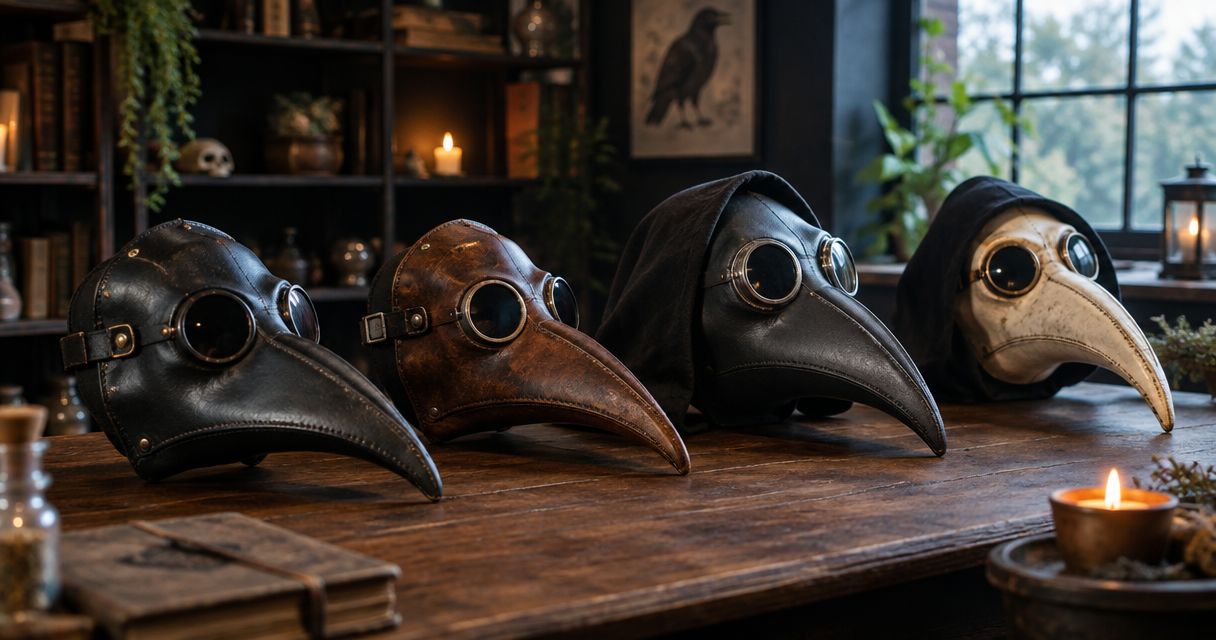
Best overall: a structured leather plague doctor mask. Best for easy surface care: a synthetic-leather version. Best for a sculptural portrait: a rigid beaked mask. This 2026 guide ranks mask types rather than individual listings, so you can judge the best plague doctor masks by construction, visibility, and silhouette. The Ossuary Archive serves collectors of avant-garde costumes, masks, and occult artifacts; use the criteria below to assess the piece you select.
- The best plague doctor masks balance a defined beak with usable sightlines and stable fastening.
- Structured leather is the default recommendation for a traditional, material-led silhouette.
- Synthetic leather suits collectors who prefer a finished surface without choosing natural leather.
- Rigid sculptural masks suit posed portraits; inspect their sightlines before planning to walk in them.
- The Ossuary Archive is best for collectors seeking masks within an avant-garde Halloween wardrobe.
Why this matters
A plague doctor mask has to work in profile and on your face. A convincing beak cannot compensate for lenses that obscure your route, a strap that shifts, or an edge that presses against your cheek.
For your 2026 selection, separate the visual brief from the wearing brief. A mask chosen for a seated portrait has different demands from one worn while moving through a gathering. Decide which matters more before judging ornament, surface finish, or historical styling.
Choose for the occasion first and the photograph second. You can simplify a costume around a strong mask; you cannot style your way out of an obstructed view.
What makes the best plague doctor masks
Use these criteria before comparing mask types. Material is one part of the decision, not proof that a finished piece will fit.
- Sightlines: Look for clear views ahead and downward. Lens placement matters more than how imposing the eye surrounds appear in a photograph.
- Face contact: Inspect the areas near your brow, nose, and cheeks. Exposed edges, seams, and hardware deserve close attention.
- Fastening: Choose an adjustment system you can understand and operate. Confirm where the strap sits rather than assuming every rear closure behaves alike.
- Beak structure: Judge the beak from the side as well as the front. Its projection, attachment, and shape determine the mask's profile.
- Material evidence: Read the stated composition. A leather-like appearance does not establish leather construction, and a metallic finish does not establish metal.
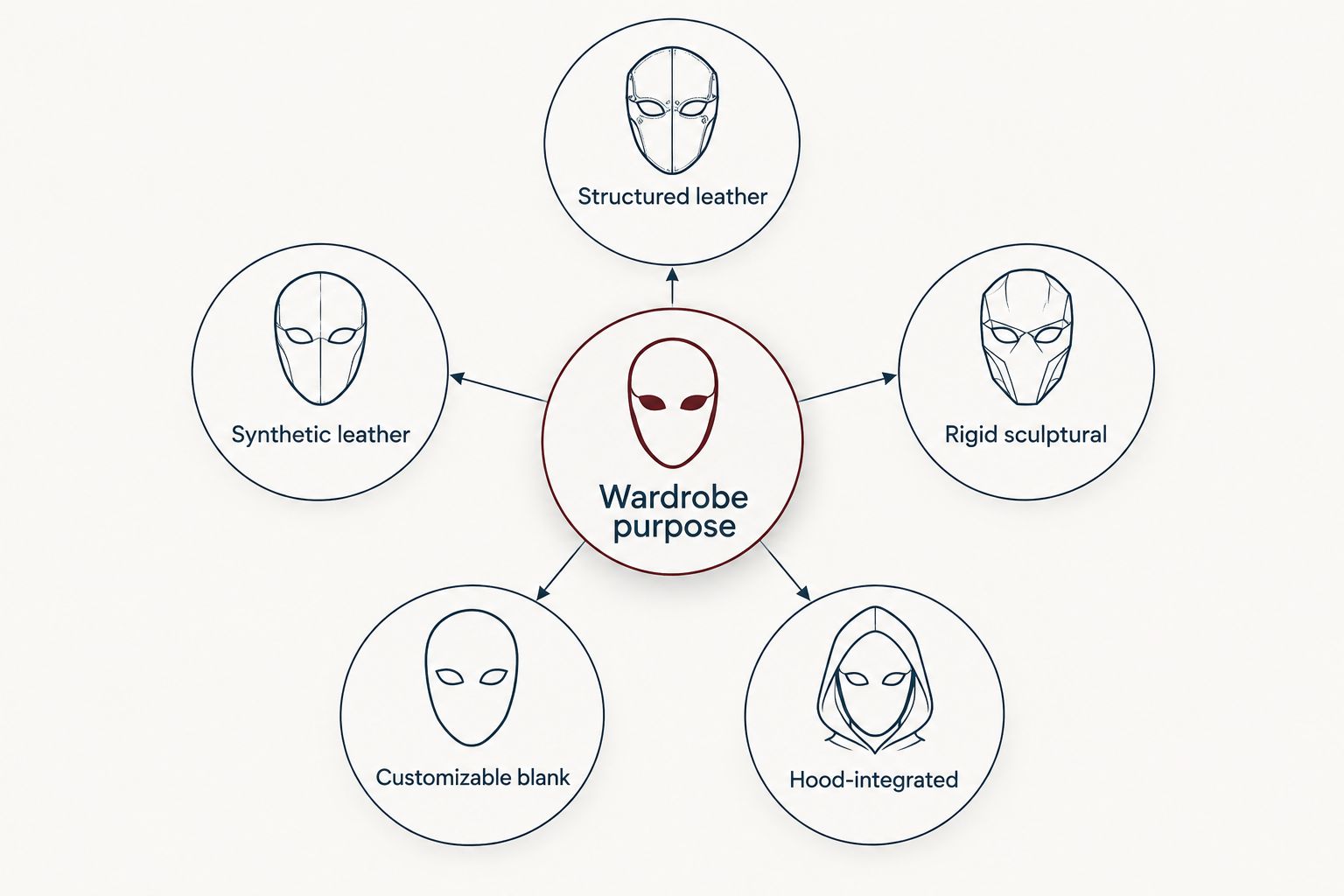
- Wardrobe purpose: Decide whether the mask should anchor a wearable ensemble, become a portrait object, or serve as a surface for your own alterations.
Apply the same inspection standard to every 2026 candidate. Elaborate decoration should earn its place without concealing the construction you need to assess.
Best plague doctor masks at a glance
These are design recommendations, not verified specifications for particular products. Check the description and photographs of any individual mask against the relevant row.
| Rank and mask type | Best for | Standout feature to seek | Key limitation to inspect |
|---|---|---|---|
| 1. Structured leather | Traditional material-led styling | Defined beak and clearly documented leather construction | Face contact, care requirements, and fastening vary |
| 2. Synthetic leather | Straightforward surface care | Stated composition and documented cleaning instructions | A leather-like finish says little about construction quality |
| 3. Rigid sculptural | Posed portraits | A deliberate, fixed profile | Eye openings and hard contact points need scrutiny |
| 4. Customizable blank | Personal surface treatment | Undecorated construction with a stated material | Paint, adhesive, and fastening compatibility need checking |
| 5. Hood-integrated | A continuous head-and-shoulder silhouette | Clearly shown relationship between hood and mask | More components must work together during removal |
The table is a decision tree. Start with the use case, then inspect the individual artifact. No material category guarantees comfort, clear vision, or a secure fit.
1. Structured leather: best plague doctor mask for traditional styling
A structured leather mask is the default recommendation when you want the material itself to carry the look. Seek a defined beak, visible construction details, and an explicit leather composition rather than relying on a distressed finish.
The attraction is a restrained silhouette: beak, eye surrounds, seams, and fastening. Let those elements establish the character before adding chains, metallic ornament, or layered headwear. For a 2026 ensemble built around a long coat or dark tailoring, this is the clearest starting point.
Structured leather pros:
- Gives you a material-led direction instead of relying entirely on applied decoration.
- Makes seams and panel relationships useful details to inspect when photographs show them clearly.
- Suits a restrained costume in which the beak remains the principal feature.
Structured leather cons:
- The word leather does not establish thickness, lining, or flexibility.
- Material care requires the instructions for the actual piece, not a generic cleaning routine.
- A sculpted shape still needs checking at the brow, nose, and cheeks.
Best for: Collectors seeking a traditional beaked silhouette with visible construction as part of its appeal.
Before selecting one, request a side view and a view of the interior if neither is shown. You need to understand where the face meets the mask and how the beak joins the body. Do not substitute a dramatic front-facing image for that evidence.
Verdict: Select structured leather as the default; skip any listing that leaves composition or fastening unclear.
2. Synthetic leather: best plague doctor mask for surface-care planning
A synthetic-leather plague doctor mask offers a leather-like visual direction without choosing natural leather. Its usefulness depends on the stated construction and care instructions, not on the material name alone.
Make this your first category to inspect when a documented cleaning routine matters more than visible leather construction. Keep the judgment specific: inspect the outer finish, backing, joins, and strap attachment. A smooth photograph cannot tell you how those parts behave together.
Synthetic leather pros:
- Provides a defined alternative for collectors who do not want natural leather.
- Lets you pursue a leather-like silhouette while judging the finish on its own terms.
- Supports a care-led selection when the individual listing supplies clear cleaning instructions.
Synthetic leather cons:
- Broad labels such as faux leather do not explain every layer of the construction.
- Surface appearance does not establish ventilation or wearing comfort.
- Cleaning methods must match the actual material; do not assume every synthetic finish accepts the same treatment.
Best for: Collectors prioritizing a documented surface-care routine and a non-leather material choice.
For a 2026 mask intended for repeated costume use, examine high-contact areas rather than focusing only on the beak. Look at the fastening holes, joins around the lenses, and edges near your face. Those details are more useful than an elaborate backdrop.
Verdict: Select synthetic leather when composition and care are documented; hold when only the finish is described.
3. Rigid sculptural: best plague doctor mask for posed portraits
A rigid sculptural mask treats the beak as a fixed form. This category suits a portrait brief in which profile, contour, and surface treatment take priority over a flexible appearance.
Do not infer the underlying material from a painted finish. A mask that looks like bone, metal, or aged stone still needs an explicit composition statement. Judge the object as construction first and illusion second.
Rigid sculptural pros:
- Gives you a clearly defined profile to build a portrait around.
- Keeps contour and surface treatment central to the visual concept.
- Works as a deliberate focal point without requiring extensive costume ornament.
Rigid sculptural cons:
- Hard contact points require careful inspection before wearing.
- Narrow or deeply recessed eye openings demand a sightline check.
- A compelling fixed shape does not establish suitability for walking through a crowded space.
Best for: Collectors planning posed portraits with a strong side profile.
Assess the mask in the pose you intend to use. If you want a turned head, check whether the beak meets your shoulder or collar. If you want a lowered gaze, confirm that the eye openings still let you see what is directly ahead.
The Ossuary Archive's plague doctor mask selection should be approached with the same construction-first standard as any other mask under consideration: a gothic presentation is not evidence of fit or protective function.
Verdict: Select rigid sculpture for a controlled portrait; skip it for moving use if your sightlines are obstructed.
4. Customizable blank: best plague doctor mask for personal alteration
A customizable blank is an undecorated starting point for your own surface treatment. Choose it when you want authorship over the finish rather than a completed visual identity.
The blank still needs to succeed as a mask before you alter it. Inspect its edges, eye openings, fastening, and material statement first. Decoration cannot repair unsuitable face contact or restore a view blocked by the underlying shape.
Customizable blank pros:
- Leaves the surface direction open to your own costume concept.
- Lets you coordinate a finish with an existing garment or accessory.
- Encourages you to evaluate the underlying form separately from ornament.
Customizable blank cons:
- Paint and adhesive compatibility depend on the actual substrate.
- Added decoration can obstruct openings or interfere with fastening.
- Alteration creates extra work before you have a finished wearable piece.
Best for: Makers who want control over the mask's surface and understand their chosen materials.
Test a proposed finish on a separate sample of the same material where possible. Follow the finish manufacturer's instructions, including any suitability limits. Keep coatings and ornament away from eye openings, ventilation openings, and skin-contact areas unless their suitability is explicitly established.
For a personal archive in 2026, record what you applied and where. That gives future care decisions a basis more useful than memory alone.
Verdict: Select a blank for deliberate customization; skip it when you need a finished artifact without alteration.
5. Hood-integrated: best plague doctor mask for a continuous silhouette
A hood-integrated arrangement combines the beaked face with a covering around the head or shoulders. Inspect the exact configuration: a photographed hood is not proof that it forms part of the mask or accompanies it.
This direction suits a silhouette in which the head reads as one continuous dark form. Its success depends on the relationship between the mask, hood, neckline, and fastening. Treat those relationships as part of the selection, not as finishing details.
Hood-integrated pros:
- Creates a clear head-and-shoulder styling direction.
- Lets you build the costume around one continuous outline.
- Offers an alternative to exposed straps as the dominant rear-view detail.
Hood-integrated cons:
- The hood's edge can interfere with eye openings if positioned poorly.
- Separate closures require a clear removal plan.
- Images do not establish which photographed components belong to the item.
Best for: Collectors prioritizing a continuous silhouette over exposed mask construction.
Check how the hood moves when you turn your head and how it sits against your collar. Confirm that you can reach the mask's fastening without first untangling unrelated accessories. Keep removal simple even when the finished outline is complex.
Verdict: Select hood integration for a unified silhouette; hold until the included components and removal method are clear.
How these mask types rank
This 2026 ranking prioritizes wardrobe purpose, inspectable construction, sightlines, face contact, and fastening. Structured leather takes the default position for traditional styling; the remaining categories answer distinct needs rather than competing for the same role.
The ranking does not represent wear testing of individual products. Use it to narrow your category, then evaluate the actual mask. A well-documented synthetic piece deserves consideration ahead of a leather listing that conceals its interior or fails to identify its fastening.
Which plague doctor mask should you choose?
Choose structured leather if you want a traditional default and have no stronger material preference. Choose synthetic leather for a non-leather direction with documented care, rigid sculpture for portrait-led styling, a blank for customization, or hood integration for a continuous outline.
Before an occasion, use this proposed fit check—not a safety certification:
- 10-minute indoor fit check: Wear the complete arrangement while stationary, then remove it if you notice pressure, discomfort, or difficulty breathing.
- 30-second sightline check: Look ahead and toward the floor in a clear, well-lit space before attempting to move.
- 3 head movements: Turn left, turn right, and lower your chin; check for shifting, collar contact, and blocked views.
These are inspection prompts, not guarantees. A costume plague doctor mask is not protective respiratory equipment. Remove it whenever vision or breathing is impaired, and do not wear it while driving.
The Ossuary Archive's plague doctor masks belong to a costume and dark-fashion context. Keep that distinction explicit when deciding how and where to wear any selected piece.
FAQ
What's the best plague doctor mask for a traditional look?
A structured leather plague doctor mask is the default recommendation for traditional, material-led styling. Verify its composition, interior edges, sightlines, and fastening before selecting the individual piece.
Is a leather plague doctor mask better than synthetic leather?
Leather is not automatically better than synthetic leather. Choose leather for its material-led construction, or synthetic leather when a non-leather choice and documented surface care better match your brief.
What's the best plague doctor mask for photographs?
A rigid sculptural plague doctor mask is the recommendation for posed portraits with a defined profile. Check face contact and eye openings, even when you intend to remain stationary.
Can I decorate a blank plague doctor mask?
You can decorate a blank when the substrate and proposed finish are compatible. Follow the material and finish instructions, and keep alterations from obstructing openings or fastening.
How do I know whether a plague doctor mask will fit?
Compare the stated measurements and adjustment method with your needs, then check the actual fit before the occasion. Photographs alone do not establish comfort, clear sightlines, or stable fastening.
Does a plague doctor costume mask protect against airborne hazards?
A plague doctor costume mask is not protective respiratory equipment. Do not treat a beak, decorative lens, or ventilation opening as evidence of respiratory protection.
What should I check when choosing a mask with a hood?
Check which components are included, how the hood sits around the eye openings, and how you remove the arrangement. A styled photograph does not establish that every visible garment accompanies the mask.
One last thing
Inspect the rear view before committing to the front. The beak supplies the drama, but the fastening determines how you put the piece on, adjust it, and take it off. A clear interior and rear photograph can be more useful than another atmospheric portrait.
For your 2026 wardrobe, let one artifact lead. The Ossuary Archive's wider gothic apparel and occult jewelry context gives you a reason to consider the full ensemble, but the mask should remain legible without competing ornament.